
 Skip to content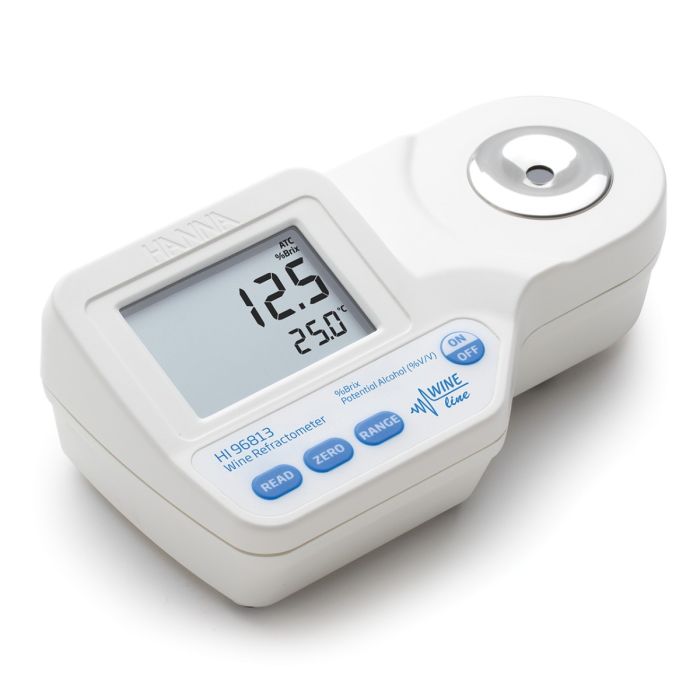

The HI96813 Digital Wine Refractometer converts the refractive index of the sample to sucrose concentration in units of percent by weight, % Brix (also referred to as °Brix). The conversion used is based on the ICUMSA Methods Book (International Commission for Uniform Methods of Sugar Analysis). Since the majority of sugar in grape juice is fructose and glucose and not sucrose, the reading is sometimes referred to as “Apparent Brix”.
The HI 96813 allows the user to tailor the instrument to their specific needs based on their experience, since no fixed conversion factor is universally applicable. The first conversion is based on the % Brix value and an adjustable conversion factor between 0.50 and 0.70 (0.55 is a common value).
Potential alcohol (%V/V) = (0.50 to 0.70) x % Brix
One drawback of the above equation is that it does not take into account the non-fermentable sugars and extract. A second equation is also available that takes these factors into account and can give a more accurate estimate of the alcohol content in the finished wine. This conversion is named “C1” on the meter, and uses the following equation:
Potential Alcohol (%V/V) = 0.059 x [(2.66 x °Oe) – 30] (C1)
* 1°Oe is roughly equal 0.2% Brix
To make a Brix Solution, follow the procedure below:
| % Brix | Sucrose (g) | Water (g) | Total (g) |
| 25 | 25.000 | 75.000 | 100.000 |
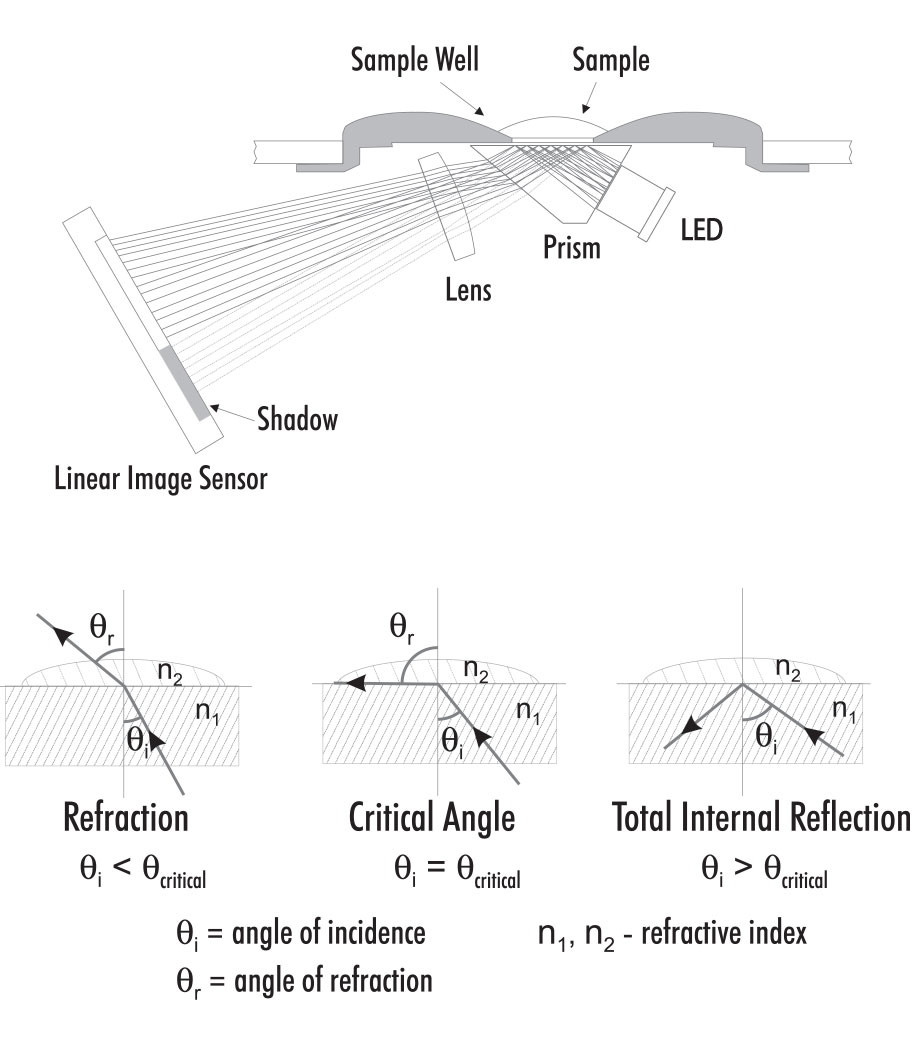
The HI96813 takes measurements based on a sample’s refractive index. Refractive index is a measurement of how light behaves as it passes through the sample. Depending on the sample’s composition, light will refract and reflect differently. By measuring this activity with a linear image sensor, the sample’s refractive index can be assessed and used to determine its physical properties such as concentration and density. In addition to the linear image sensor, the HI96813 uses an LED light, prism and lens to make measurement possible.
Variations in temperature will affect the accuracy of refractometry readings, so the use of temperature compensation is highly recommended for reliable results. The HI96813 contains a built-in temperature sensor and is programmed with temperature compensation algorithms in accordance with the ICUMSA Methods Book Standard for a percent by weight sucrose solution at 20℃. These compensation algorithms vary based on the parameter being measured.
One-point calibration
Small sample size
Automatic Temperature Compensation (ATC)
Quick, accurate results
Dual-level LCD
Stainless steel sample well
Battery indicators
Automatic shut-off
IP65 water resistant protection
 BannerText_Seraphinite Accelerator