
 Skip to content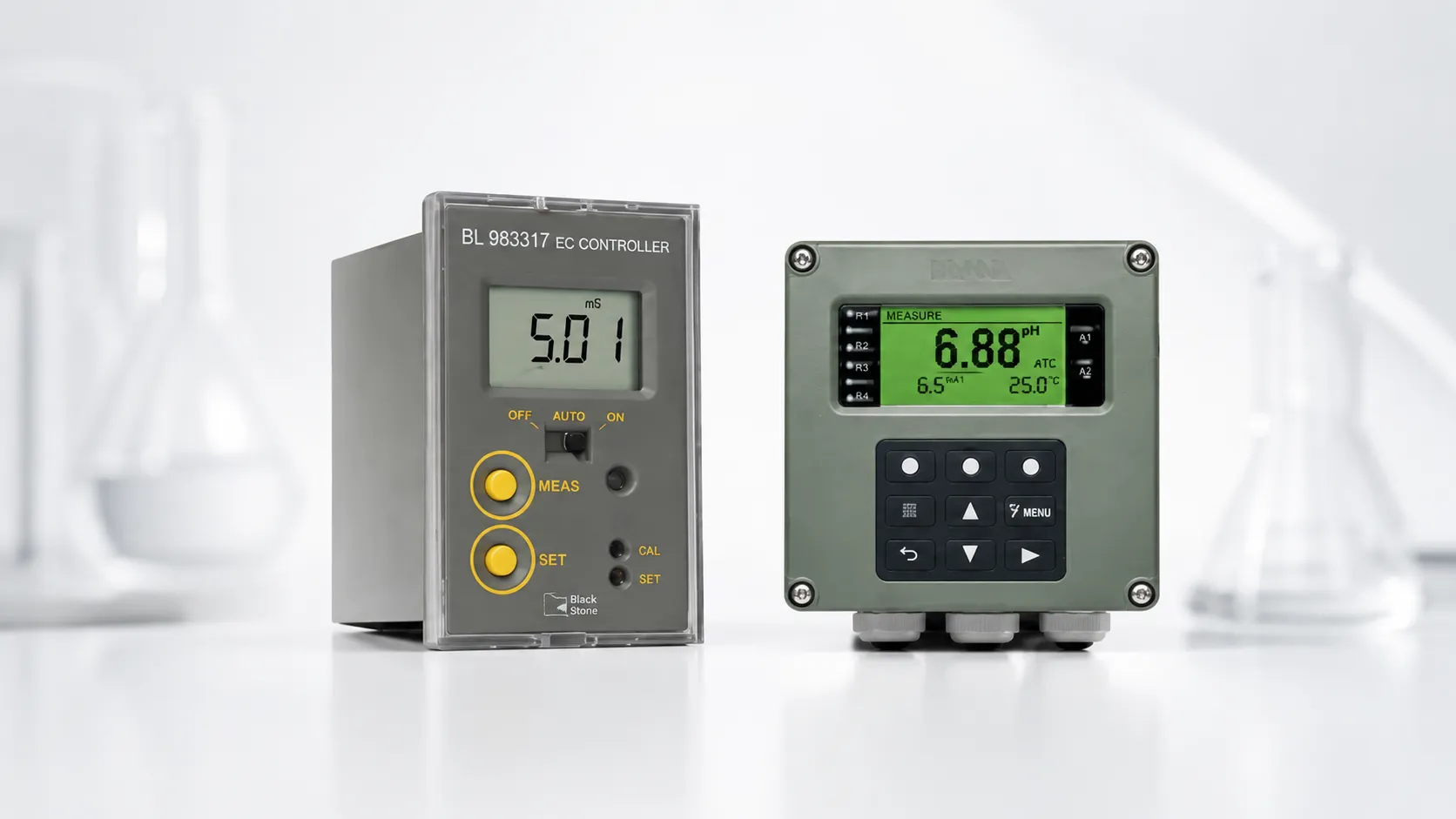
A Hanna Controller is an automated control instrument made by Hanna Instruments that continuously monitors a water or process parameter — typically pH, ORP (oxidation-reduction potential), or a disinfectant such as chlorine — and triggers a dosing pump, valve, or relay to keep that parameter within a set target range. Instead of an operator manually testing water and adjusting chemical dosing by hand, a Hanna Controller reads the parameter in real time and automatically corrects it, which is why these instruments are used across water treatment, pools and spas, boiler and cooling systems, and industrial process lines.
Chemstock supplies Hanna Instruments products, including Hanna Controller units, to laboratories, water treatment companies, and industrial facilities across Oman and the GCC.
A Hanna Controller is a dedicated instrument that measures a specific water or process parameter through a connected probe or sensor and automatically activates a dosing pump, solenoid valve, or relay output when the reading moves outside a pre-set range. The core function is closed-loop control: measure, compare against a setpoint, and act — without requiring an operator to manually intervene for every adjustment.
Controllers differ from standalone testing instruments such as handheld meters or colorimeters. A handheld meter or a Checker-style colorimeter gives a single reading at the moment of testing. A controller, by contrast, monitors continuously and is wired into the dosing or treatment system so it can respond automatically as conditions change throughout the day.
A Hanna Controller works by taking a continuous or repeated reading from a probe (such as a pH or ORP electrode) immersed in the process water, comparing that reading to a target setpoint programmed by the operator, and switching an output — usually a relay connected to a dosing pump — on or off to bring the parameter back toward the setpoint.
The general operating sequence is as follows:
Because the controller depends on an accurately calibrated probe, calibration frequency and probe condition directly affect how reliably the system performs. A drifting or fouled probe can cause overdosing, underdosing, or false alarms even if the controller electronics are functioning correctly.
A Hanna Controller is used to automate the monitoring and correction of parameters such as pH, ORP, and disinfectant residual in water and process systems, reducing the need for manual testing and manual chemical dosing. This makes it suited to any application where a parameter needs to stay within a defined range continuously rather than being checked periodically.
Common use cases include:
| Industry | Application | Typical Requirement |
|---|---|---|
| Water treatment | Automated pH and disinfectant dosing | Continuous compliance with treated water targets |
| Oil & gas / petrochemical | pH and ORP control in process and wastewater streams | Consistent process chemistry with minimal manual intervention |
| Power generation | Boiler and cooling water chemistry control | Stable pH and dosing to limit corrosion and scale |
| Food & beverage | Process water and CIP (clean-in-place) system control | Consistent water chemistry supporting product and equipment safety |
| Hospitality (hotels, resorts) | Pool and spa chlorine or bromine dosing control | Continuous disinfectant levels for bather safety |
| Manufacturing facilities | Cooling tower and effluent treatment control | Reduced manual dosing and more stable process chemistry |
| Laboratories & research institutions | Controlled experimental setups requiring stable pH or ORP | Repeatable conditions for testing and process work |
Automated control reduces the labor involved in manually testing water throughout the day and lowers the risk of a parameter drifting out of range between manual checks, which matters in applications like disinfection where a gap in dosing can create a compliance or safety issue. Compared with manual dosing based on periodic handheld readings, a controller responds continuously, which generally produces more stable process chemistry.
The trade-off is that a controller is a capital investment requiring correct installation, a properly matched dosing pump, and ongoing probe calibration and maintenance. A controller left with an uncalibrated or degraded probe can create a false sense of security, since the system will continue dosing based on an inaccurate reading unless the probe is checked and maintained on a regular schedule.
| Factor | What to Check | Why It Matters |
|---|---|---|
| Parameter to control | Confirm whether you need pH, ORP, disinfectant residual, or another parameter | Determines the correct controller type and compatible probe |
| Setpoint range and control band | Match the controller’s adjustable range to your process target | A mismatched range limits control precision or usability |
| Probe compatibility | Confirm the correct probe type and connection for your application and water matrix | Probe mismatch affects measurement accuracy and lifespan |
| Dosing pump compatibility | Check the relay or output type against your existing or planned dosing pump | Ensures the controller can actually activate your dosing equipment |
| Installation environment | Consider ambient temperature, humidity, and whether the unit is indoor or outdoor rated | Affects long-term reliability and enclosure requirements |
| Calibration and maintenance needs | Ask about calibration frequency and probe replacement intervals | Ongoing accuracy depends on a realistic maintenance routine |
Probes connected to a Hanna Controller should be stored and maintained according to the manufacturer’s instructions for that specific probe type, since pH and ORP electrodes generally require storage in an appropriate storage solution to prevent the sensing element from drying out. Regular calibration against fresh buffer or standard solutions is necessary to keep readings accurate, and the frequency should be set according to how demanding the application is — a critical disinfection process typically warrants more frequent verification than a lower-risk industrial process. The controller unit itself should be installed in an environment consistent with its rated operating conditions, and wiring to dosing pumps or relays should be inspected periodically as part of routine facility maintenance. Buyers should consult Hanna Instruments’ official product documentation for the specific calibration schedule, probe storage requirements, and environmental ratings applicable to the exact controller model selected.
A controller that is poorly matched to its application, or left with an uncalibrated probe, can cause more harm than manual testing because it continues to act on inaccurate data without an operator noticing immediately. In disinfection applications, this can mean under-dosing that allows microbial risk to increase, or over-dosing that wastes chemical and can create handling or compliance issues. In industrial process lines, incorrect pH or ORP control can accelerate corrosion or scale formation in equipment. Selecting a controller matched to the application, paired with a realistic calibration and maintenance schedule, is what makes automated control genuinely more reliable than manual testing rather than simply more convenient.
Automated dosing and process control is increasingly relevant across Oman’s water treatment plants, oil and gas facilities, power and desalination operations, hospitality sector, and food and beverage manufacturers, where consistent water chemistry supports both compliance and equipment protection. Facilities in Oman’s industrial zones and coastal cities often look for controllers that can operate reliably in warm ambient conditions and integrate with existing dosing pump infrastructure already installed at the site.
For businesses sourcing a Hanna Controller in Oman, key purchasing considerations include confirming the controller and probe combination suits the specific water matrix and parameter being controlled, checking that replacement probes and calibration solutions will be available locally for ongoing maintenance, and factoring in delivery logistics to sites across Muscat and other regions of the Sultanate. Chemstock supplies Hanna Instruments products, including Hanna Controller units, to laboratories and industrial customers across Oman and the broader GCC region.
Chemstock distributes Hanna Instruments products, including Hanna Controller units, alongside a broader laboratory and industrial chemical supply catalog serving Oman, the UAE, and the wider GCC and MENA region. For buyers unsure which controller and probe combination matches their application, Chemstock can advise on parameter selection, probe compatibility, and dosing pump integration based on the specific process.
Chemstock supplies Hanna Controller instruments and compatible probes to laboratories, water treatment operators, and industrial facilities in Oman and across the GCC. Whether you need a single-parameter controller for a pool or spa system or a process controller for an industrial dosing application, Chemstock can help confirm the right specification for your facility.
Need a quotation or technical assistance? Contact Chemstock to discuss your product requirements, specifications, quantities, and delivery location in Oman or the wider GCC region.
What is a Hanna Controller used for?
A Hanna Controller is used to automatically monitor and correct a water or process parameter — such as pH, ORP, or disinfectant residual — by activating a dosing pump or relay when the reading moves outside a programmed range. It replaces manual testing and manual dosing with continuous, automated control.
How is a Hanna Controller different from a handheld pH or ORP meter?
A handheld meter gives a single reading at the moment of testing and requires an operator to act on that reading manually. A Hanna Controller monitors continuously and automatically activates a dosing pump or relay output, correcting the parameter without requiring constant manual intervention.
Does a Hanna Controller need regular calibration?
Yes. The probe connected to a Hanna Controller requires regular calibration against fresh buffer or standard solutions to maintain accurate readings, since probe drift over time can cause the controller to dose incorrectly even if the electronics are functioning normally.
Can a Hanna Controller be used for pool and spa chlorine dosing?
Yes. Controllers configured for disinfectant residual or ORP control are commonly used in pool and spa applications to maintain a target chlorine or sanitizer level automatically, reducing the need for manual testing throughout the day.
What parameters can a Hanna Controller monitor? Hanna Controller instruments are generally used to monitor and control parameters such as pH, ORP, and disinfectant residual, depending on the specific model and probe configuration selected for the application.
Where can I buy a Hanna Controller in Oman? Chemstock supplies Hanna Instruments products, including Hanna Controller units, to laboratories and industrial customers in Oman and across the GCC. Contact Chemstock directly to confirm model availability and request a quotation.
What should I check before buying a Hanna Controller?
Confirm the parameter you need to control, probe compatibility with your water matrix, dosing pump or relay compatibility, the controller’s setpoint range, and the installation environment, since these factors determine whether the controller will perform reliably in your specific application.
Does a Hanna Controller replace the need for manual water testing?
A controller significantly reduces manual testing frequency but does not eliminate the need for periodic manual verification, since probe calibration checks and independent spot-testing remain important to confirm the controller is reading accurately over time.
Can a Hanna Controller be used in industrial process water applications?
Yes. Hanna Controller units are used in industrial settings such as boiler feedwater, cooling towers, and wastewater treatment to automate pH or ORP correction, helping maintain stable process chemistry with less manual dosing labor.
What maintenance does a Hanna Controller probe require?
The probe should be stored according to the manufacturer’s instructions, typically in an appropriate storage solution to prevent the sensing element from drying out, and calibrated on a regular schedule matched to the demands of the application, with more critical applications generally requiring more frequent verification.
From water testing to laboratory analysis, Hanna Instruments provides accurate, reliable, and easy-to-use instruments for a wide range of applications. Get expert guidance to find the right Hanna solution for your needs.
Have questions about Hanna Controller products or need help selecting the right instrument for your application? Fill out the form below, and our team will get back to you with the best solution for your business or laboratory.
Have questions about our products or need help selecting the right laboratory equipment or chemicals? Fill out the form below, and our team will get back to you with the best solution for your business or laboratory.
 BannerText_Seraphinite Accelerator